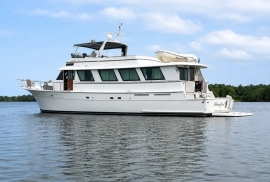
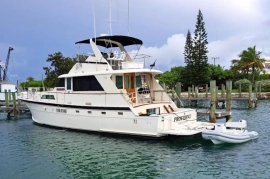
In the turbulent waters off North Carolina's Outer Banks, where the cold Labrador Current clashes with the warm Gulf Stream at the infamous Diamond Shoals—known as the "Graveyard of the Atlantic"—a bold vision took shape in 1959. Textile magnate and avid angler Willis Slane, frustrated by wooden boats that cowered before the pounding waves of Cape Hatteras, rallied fellow fishermen and investors to create something unbreakable. Enlisting fiberglass pioneer Don Mucklow for production and young naval architect Jack Hargrave for design, they birthed the Hatteras Yacht Company in High Point, North Carolina. Their mission: craft a vessel tough enough to chase marlin without retreat.
Slane's gamble on fiberglass—a lightweight, rot-proof alternative to wood—ignited a revolution.
The inaugural Knit Wits, a 41-foot convertible sportfisher launched in 1960, planed at over 30 knots through rogue seas, proving fiberglass could handle offshore brutality. This wasn't just a boat; it was a declaration of dominance, setting the gold standard for production yachts with its flared bow, sharp entry, and unyielding hull.
The 1960s roared with expansion. By 1962, Hatteras unveiled the world's first fiberglass motor yacht, the 41 Double Cabin, blending luxury with seaworthiness. Models proliferated—34-foot expresses, 50-foot convertibles—catering to a booming post-war leisure market. Tragedy struck in 1965 when Slane died at 44, but under successor David R. Parker, the company surged forward, opening a sprawling New Bern facility in 1967 to meet demand for ever-larger builds.
Economic headwinds and oil crises tested Hatteras in the 1970s, yet innovation prevailed. The decade saw the launch of the iconic 53-foot series—the most produced model ever, with 349 motor yachts and 224 convertibles—and the pioneering Long Range Cruiser, a blueprint for fuel-efficient bluewater voyaging. By the 1980s, amid recessions, Hatteras pushed boundaries with 70- and 80-foot sportfishers, then 100-foot superyachts, earning acclaim for over-engineered details like vacuum-bagged hulls and noise-dampening isolation.
The 1990s brought corporate shifts: Genmar Industries acquired Hatteras in 1990, followed by Brunswick Corporation in 1996, infusing resources for semi-custom luxury. Ownership changed again in 2013, when Versa Capital Management bought it alongside sister brand Cabo Yachts. Challenges persisted—Brunswick's 2021 sale to White River Marine Group (affiliate of Bass Pro Shops founder Johnny Morris) amid market flux—but Hatteras rebounded with grit. The 2023 layoffs of 80 workers in New Bern, tied to economic pressures and tooling investments, were a pivot, not a pause. In 2024, Hatteras announced its next-generation lineup—the Bimini Run (48'), Cat Cay (66'), and Chub Cay (77')—with deliveries underway in 2025, signaling a renaissance under Morris's vision of a coastal innovation hub.